Christie Noble’s disappearance
Point BlankChristie Noble’s disappearance is the unresolved loss at the center of Dixon Noble’s family life: she vanishes without a known explanation, and nearly three years of investigation produce no clue about where she went or what happened to her. Erin Bushnell’s case gives Dixon a frightening comparison, not an answer. He believes Christie is dead and that she would never have left her husband and sons willingly, yet the absence of evidence leaves the family unable to know how she died or who was responsible.
Background and the Erin Bushnell case
Dixon’s history emerges when the investigation into Erin Bushnell’s death turns from the crime scene to the possibility of a person disappearing without a trace. Dixon reflects that, had Ruth Warnecki not entered Winkel’s Cave on the particular day she did, Erin might have vanished from everyone’s knowledge. He imagines how such an absence could be mistaken for a voluntary departure, including the possibility that the missing person had gone away with someone. The thought arrests him: he falls silent, looks down, and holds his hands clenched on his thighs. Ruth notices his pallor and asks what happened to his wife.
Dixon then reveals that Christie disappeared nearly three years earlier. The parallel with Erin is not evidence that the two cases are connected; it is the possibility of an undiscovered fate that unsettles him. Since Ruth found Erin, Dixon has repeatedly wondered whether Christie might have suffered something similar. Dillon Savich acknowledges how painful that uncertainty must be for Dixon and his sons, while cautioning that Christie’s disappearance is highly unlikely to have anything to do with Erin’s murder. The comparison therefore sharpens the emotional stakes without supplying a solution.
The search and the absence of an answer
Christie was simply gone one day. Dixon says that a substantial criminal investigation followed and that the family did everything they could to find her. He also hired a private investigator he had heard about in Chicago. None of these efforts uncovered a single clue or lead. The length of the silence—nearly three years by the time Dixon speaks about it—does not make the disappearance more intelligible; it makes the lack of an answer part of the family’s daily reality.
Dixon is certain about what Christie would not have chosen: in his view, she would not willingly have left him and their boys. From that conviction he concludes that someone took her and killed her, although he does not know who. His certainty about her character and his belief in her death do not amount to proof of either the circumstances or the perpetrator. He continues to search for information, and the story does not resolve the case with a body, a discovered clue, or a confirmed account of her fate.
What the family can tell itself
The disappearance shapes how Dixon speaks with his sons. In the early period after Christie vanished, he was consumed by the effort to find her and did not know how to sort through the boys’ feelings with them. When his own mind began to clear weeks later, he understood that they needed to talk about their mother and that he needed them too. He tried to give them as much honesty as he could. At the same time, he kept his own pain buried for their sake, and the family gradually adjusted to what could not be changed.
That adjustment did not mean the boys had accepted their mother’s death. When they raise the subject again, Dixon understands their reluctance to accept that she is dead because he has experienced the same denial himself. He tells them that no illness or other circumstance would have made Christie leave without a word, and he asks why they had kept their fears from him. Rob explains that they spoke because of Ruth and her growing place in their father’s life. The disappearance has thus left the boys not only grieving but also uncertain about whether a new attachment might displace their mother.
Dixon responds by making the distinction between absence and death explicit. He tells his sons that he believes Christie died, while also promising that he will never stop looking for what happened to her. He acknowledges that he had been too reluctant to press the truth because he wanted to spare them pain, and says that keeping it buried was unfair to all of them. His account preserves two needs at once: the family must face the likelihood of Christie’s death, and it must not mistake that belief for knowledge of her fate.
Continuing loss and the possibility of change
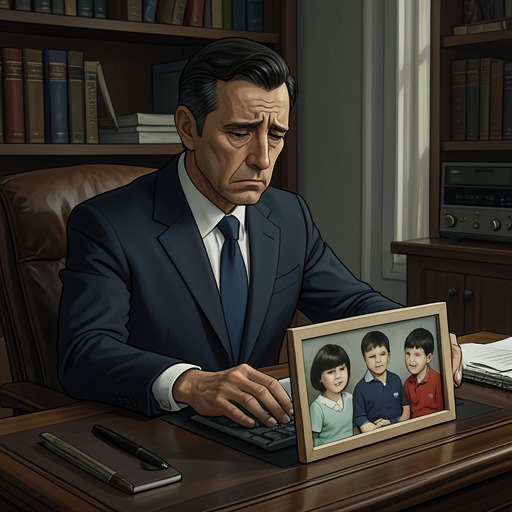
The unresolved disappearance remains present in Dixon’s life years later. At night, he thinks of Christie and of the disruption to the peaceful town he once knew. Her photograph remains on his desk at work; it shows her with the boys a month before she vanished. He looks at it every day and wonders what happened. The photograph fixes a moment before the disappearance, while the missing explanation keeps that moment from becoming a closed past.
Dixon’s emerging relationship with Ruth makes the family’s unspoken grief newly visible. After he kisses Ruth, Rob identifies the source of the boys’ distress as their mother. Dixon realizes that his sons had understood their shared honesty to include their feelings about Christie, while he had allowed his own sorrow to remain buried. When Ruth has lived with Dixon and the boys for a week, she begins to feel at home with them, and Dixon himself uses that word for their shared destination. The closeness offers the possibility of life moving forward, but it does not settle what happened to Christie. Ruth also believes Christie would not have left her family willingly, reinforcing the family’s conviction without turning it into a solved mystery.
Christie’s disappearance consequently functions as more than an unanswered investigative question. Its central uncertainty—physical absence without an explanation or farewell—continues to govern the family’s grief, the boys’ guardedness, and Dixon’s effort to balance hope for knowledge with acceptance of what he believes. The case remains open in both senses: no one has established Christie’s fate, and her absence still shapes how the living speak to one another and make room for change.